Wednesday, July 16, 2014

Bloom Day July 2014


Happy Bloom Day for July and thank you to all the other garden bloggers that post all the amazing photos and the source for the whole day http://www.maydreamsgardens.com/.  Thank you for inspiring me to share my garden and for sharing yours, please visit May Dreams Gardens to see her's and so many others...

On to my blooms...


We are in a drought here in California, not that you would know it from my pictures. But the lawn is on its last strands and the spring veggies were left to flower for the bees.  Yet that has left water for the rest of the yard and collection.

And right now everything is scrambling to bloom, perhaps in a scramble to survive in anyway possible watching the water being so much more selective.  Or maybe it is just that time.


This is Mirabilis longiflora which either really scrambling to make more seed than ever or has just really come into its prime size after four years.  It is a perennial, zones 7-10, that grows a large underground tuber that it returns from each late spring after going to sleep and dying back to the ground each fall.  

It is a four o'clock, but not the common one you would associate with that name, and oh so much more fragrant.  It is a great evening scented garden plant.  I have them planted with several Brugmansias to add to that effect.


Amazing long flower tubes to boot.


Now walking past them the tiger lilies are in full bloom.  You can see the orange above and here they are closer.
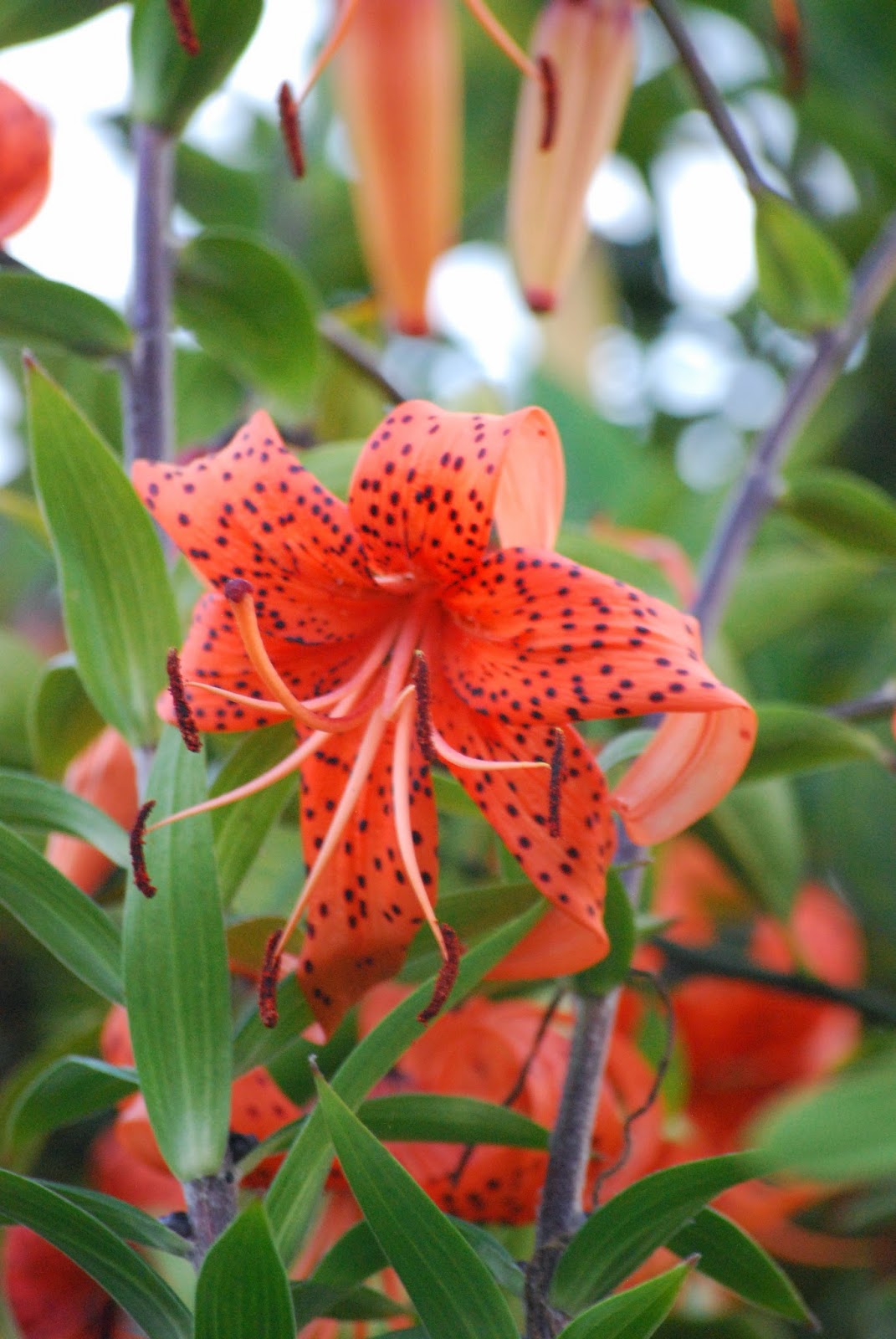

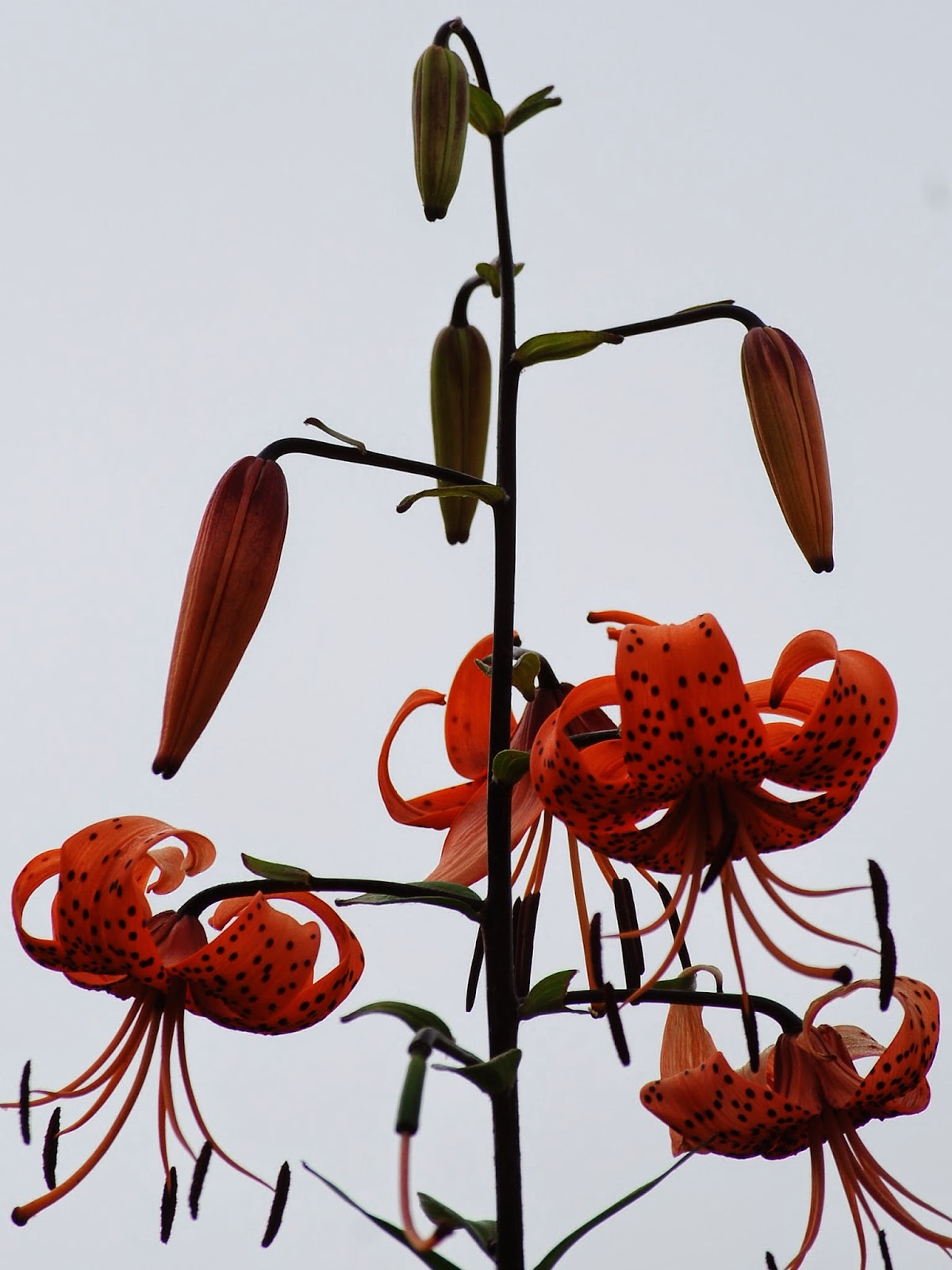
I believe they are Lilium lancifolium or Lilium tigrinium, but I did not buy them. I started the first ones 12 years ago from some bulbils from a specimen at an old and now gone favorite restaurant.  The bulbils grow on each leaf of the upper third to two-thirds of mature plants.  They grow the first year as a single leaf, the next as a small stalk with five to ten leaves, and then take off. These are about five years old



And growing near by, actually right along side Mirabilis longiflora, is one of my favorite Brugmansias, this is 'Pink Perfection' that I have had for about five years now and it has reached a nice 8-10 feet tall.


It is a double with color and that actually has the double extended out of the outer flower and opens fully unlike the common double white that is a tight wad of blooms.


A leek that I left in the veggie garden to set seed.


 Here is Antirrhinum majus ‘Chantilly Peach’ catching a little of the morning fog...


Digitalis obscura "Sunset Foxglove"


Fuchsia 'Nettala'


Bomarea 'Fiesta' climbing up 12 feet to grab a little sun and some humming bird beaks.  I believe it is Bomarea caldasii.


Begonia luxurians


I'll have to post more photos of that Begonia as it is the Palm leaf begonia. One unlike any other and it grows 4-6 feet tall... but since this all about Blooms you get just that photo for now...

And now walking over the the cloud forest corner of the back yard and more Brugmansias. First the tight wadded up 'Double White' this is one that is found in several yards around town and go back as far as anyone remembers.  Since I have a couple newer hybrids with better descending ones I call these the common double white or the classic double white--but no one appointed me to name anything so it may not matter...


Next Brugmansia x versicolor 'Ecuador Pink' showing a little less due to dry ground.  The dead branches are from a couple days hard frost last winter so all in all it is doing great being nocked around by the seasons.


Brugmansia 'Emerald Frost' (A frosty pink with slight green on green variegated leaves)


Brugmansia 'Sera' one of my own hybrids yet to be registered


Another unnamed hybrid off a Frosty pink plant that I hybridized.  It is just like one on the market called 'Betty Marshal' but I think of them as the wild white as the pink and yellow ones of the this variety mostly revert to this white.


Fuchsia fulgens variegata


Some sort of Ismene × festalis (syn. Hymenocallis × festalis) 


Lupinus arboreus


A nice and easy, if a bit weedy, Nicotiana. These came up the next year from a variety called Bella that was red, or got into the garden on its own... 


Fuchsia 'Michael's Yellow Surprise'


Some Borage to feed the bees


Impatiens glandulifera


And since anticipation is one of the major fuels in a love of gardening here is a bud yet to find its glory.  A sunflower volunteering after surviving the beaks at the bird feeder.


Tuesday, October 15, 2013

Furcraea foetida Mediopicta


Here is a new addition this summer to my garden that helped fuel my love (or is addiction) for unusal and variegated plants.


It is an agave relative.  Grows pretty large and has amazing layers of white and green.  They also bloom similar to agave, only once in 5-15 years and then die, usually leaving offsets behind.  Yet this one does like Agave vilmoriniana and not just flowers, but also produces hunderds of bulbils on the flower stalk.


Mature size can be 5-8 feet tall and wide, but in a large but not too large container can stay smaller for years.


This one does a great job of layers of green under and over white, each leaf a bit different than the last.


It is harder to zone 9ish, 25-30 degrees F, and has suvived my central coast brief frosts just fine and I see lots of non-variegated ones surviving to maturity around town.


Monday, October 14, 2013

Sansevieria kirkii var. pulchra ‘Coppertone’ -- Take 2

This is a quick follow up on my post a couple weeks ago on Sansevieria kirkii var. pulchra ‘Coppertone' that was just starting to bloom.  I was able to get some follow up shots of the blooms while open.  See original post here.


The best shots all had to be at night as it appears to be a night blooming plant and they only lasted 12-24 hours at most with all new blooms opening at dark.  A fact that seems confirmed by Wikipedia noting that most species are pollenated by moths.


They are also scented, something a bit like baby powder with a subtle fruity or candy hint.  Maybe like 75% baby power and 25% cotton candy.  It was not very strong from any distance but easy to smell close up.


Once a growing rosette/shoot flowers it will not grow any new leaves, but will stay alive for years.


Each night a few more would bloom then fade.   I tried to pollinate it but it was the only one I had blooming of any of my collection and have never had any others pollinate.  But I am still watching hopefully for a seed pod (berry like) to appear under the dead flowers.


Thanks for looking!


Saturday, September 21, 2013

Puya mirabilis


This is a very nice, compact, and low thorn Puya.  Also a must for those of us with a fetish for chartreuse or green flowers.


I love the contrast of the dark brown and light green.


The old flowers also do a neat twist/cork screw effect as they whither away.  I have pollinated these and grown many from seed.


One more flower...

Unlike the first Puyas I tried these are small 1 foot rosettes, not the hughe 5 foot clumps of Puya berteroniana.  Though P. berteroniana has almost more amazing blue flowers with orange pollen--it is just full of razor sharp teeth on every blade and too big for me.  This one has some teeth, but just small and only a bit painful and only if you grabbed a handful.


If you can handle aloes and agave you wouldn't be bothered by this.  So don't think all Puya are death traps...  The P. berteroniana has myths told about it ensnaring small animals in its thorns and benefiting from the added nourishment--that is not this plant at all.  Sorry I probably should not perpetuate what I bet is not true for any Puya, but some really are that sharp and the thorns angle just that way so that what gets in really can't pull back out.

This this is now my only Puya.  I just visit the big guys at the S.F. Arboretum!   


Stats:

  • Native to Bolivia
  • Blooms in about a year after planting, 2 from seed--not the decade of some Puyas
  • About 1 foot by 1 foot, maybe 2 with time
  • Hardy to 20 degrees...  Has survived for me in wet winters and frosts in the 28 degree F, but I suspect best hardiness is to keep it dry and not wet all the time.


Sansevieria kirkii var. pulchra ‘Coppertone’


 This is one of my favorite Sansevierias. The metallic and wavy look of the leaves reminds of the results of fold forming copper especially when tarnished later and burnt well with a torch in the annealing steps.  The color is better or more coppery in brighter light. 


And this month I am getting a rare treat... blooms.  


These are way more spectacular plants if they were grown outdoors with bright light.  But like almost everyone mine is a house plan since they are on a zone 10 or 11 plant at best.  And they take low light with little complaint at all except darker color and less growth.

Here is a copy leaves that are newer and have been getting the sun from the window they sit next to.


The plan can grow so leaves over 1.5 feet so needs a large table sometimes to not have leaves reaching out at people, but I am happy with the size.  And the hiegt has never been over 2 feet and the tend to arch more horizontal than up.


Stats:

  • Full Sun to Partial Shade 
  • Balanced fertilizer a couple times a year--but don't over do it and does need some to flower along with light.
  • Flowers sporatically over year
  • Low water needs, I use clay pots that breath--your average terracotta, not glazed--though rot is not a big problem, just never had it happen this way and have in glazed pots with poor drainage.
  • Zone 10-11 if daring to try outside
  • Growth is to a 2 foot rosette 
  • Good houseplant, but will grow slow in low light--which is perfect if you want that basic size you have, bad if you love see plants grow fast and send you new leaves to look at each month.


Wednesday, August 14, 2013

Six-pointed Brugmansia Take Two - Brugmansia Kaia

Here is another set of pictures of six pointed flowers on a Brugmansia.  This is a rare occurrence, with almost all flowers being five pointed.  It is kind of like finding a four leaf clover.  Only I have enough to see it maybe a bit more often than that.  Most of mine are in the B.suaveolens or hybrids with it so it seems more common there.

This one is one of my own named after my oldest daughter, Kaia


It is the result of a yellow and pink cross of two other B.suaveolens.


It has maintained both the yellow and pink coloring, or I guess the pink is pretty orange... but knowing it was crossed with Brugmansia 'Frosty Pink' I see the link.


I made the cross and grew this out from seedlings about 6-8 years ago.  It has had many sets of six pointers usually with the first flush of flowers after each rest.  By rest I mean that this type flowers in flushes throughout the growing season then rests or produces few if any blooms for a period before setting lots of bugs again.  This is a common pattern for Brugmansias.


The orana-pink is sometimes a darker...


 Here is the plant from a distance to get an idea of size and what it looks like in flower.


It is a medium to smaller sized Brugmansia, growing 4-8 feet depending on your pruning or feeding.  Thanks for looking!  I have some more pics of a white six-pointer, but will get to that later to still make this seem like a special occurrence!

Saturday, July 27, 2013

Six Point Brugmansia

I am not sure which is more common this or four leaf clovers, but these are special...  a six point Brugmansia, an offspring of Jamaican Yellow:


Now this is not a lucky new mutation, just something a plant will do once in a great while, usually younger plants or the on of the first spring flowers.  In my experience I have also only seen in my Brugmansia suaveloens relatives.  Most flowers are only five points like this one on the same plant:


So like finding a four leaf clover it is an occasion to grab the camera, call anyone who'd care, etc.  So with out more words here is a series of nice shoots of one...